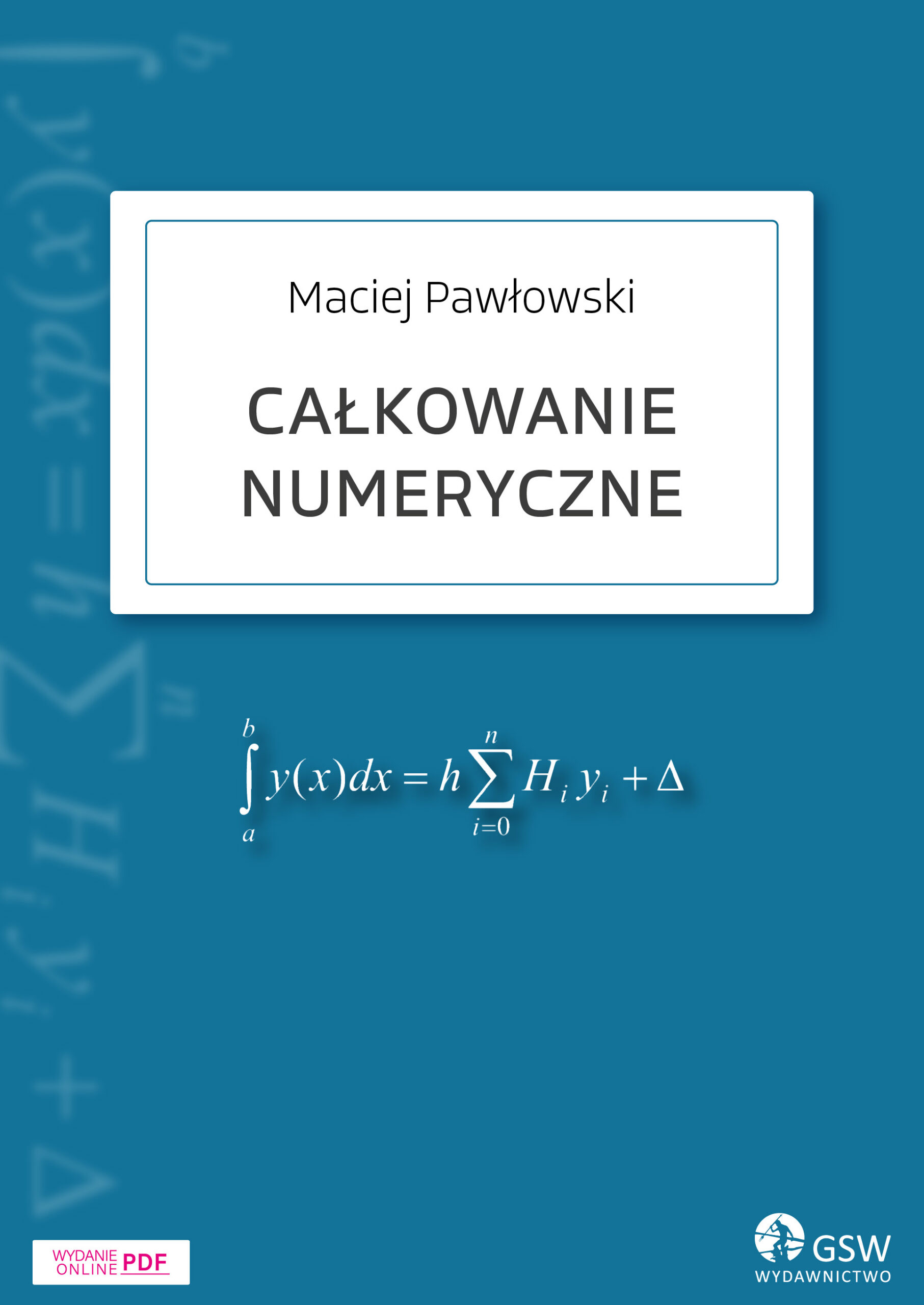
Całkowanie numeryczne Macieja Pawłowskiego jest podręcznikiem akademickim poświęconym metodom numerycznego obliczania całek oznaczonych. Publikacja przedstawia zarówno podstawy teoretyczne całkowania numerycznego, jak i liczne metody obliczeniowe, przykłady oraz zadania pozwalające na ich praktyczne zastosowanie. Punktem wyjścia jest sytuacja, w której funkcja podcałkowa może być określona analitycznie, tabelarycznie lub graficznie, a zastosowanie metod analitycznych jest niemożliwe, niecelowe albo zbyt skomplikowane. Autor systematycznie wyjaśnia rolę interpolacji, węzłów, współczynników wagowych i błędu metody oraz pokazuje zależność dokładności całkowania od sposobu aproksymacji funkcji podcałkowej.
Obszerna część książki dotyczy klasycznych metod całkowania funkcji regularnych. Omówiono metodę Lagrange’a, rozwinięcia w szereg, wzory o najwyższych rzędach dokładności oraz metody Newtona-Cotesa, w tym wzór trapezów i wzór Simpsona. Autor przedstawia sposoby szacowania błędów i zwiększania dokładności obliczeń, m.in. poprzez zmniejszanie kroku całkowania, ekstrapolację Richardsona oraz metodę Romberga. Analizowane są również wzory 5–8, uogólniony wzór paraboliczny, obliczanie krzywych całkowych oraz metoda prostokątów. Liczne przykłady pokazują nie tylko sposób stosowania poszczególnych algorytmów, lecz także pozwalają porównywać ich dokładność i efektywność.
Kolejne partie publikacji poświęcono metodom Czebyszewa i Gaussa oraz zagadnieniom całkowania w bazie Czebyszewa i metodzie interpolacji Czebyszewa. Szczególną uwagę zwrócono na numeryczne całkowanie funkcji nieregularnych i osobliwych z wykorzystaniem funkcji wagowych. Omówiono m.in. wzory Gaussa-Czebyszewa, całkowanie z różnymi funkcjami wagowymi oraz całkowanie w przedziałach nieskończonych za pomocą wzorów Laguerre’a i Hermite’a. Dzięki temu książka wykracza poza podstawowy zakres typowych kursów metod numerycznych i obejmuje również problemy wymagające bardziej zaawansowanych narzędzi matematycznych.
Odrębną część stanowią specjalne metody całkowania, często pomijane w podstawowej literaturze przedmiotu. Autor omawia całkowanie tłumionych funkcji okresowych, wykorzystanie planimetru oraz całkowanie za pomocą krzywych giętkowych, w tym interpolację trzy- i wielopunktową oraz analizę ugięcia giętki. Przedstawiono także sposoby ścisłego obliczania wybranych całek z pominięciem funkcji pierwotnej, m.in. przez sprowadzenie do całki zależnej od parametru, podnoszenie całki do kwadratu i sprowadzanie problemu do równania, a także całki Frullaniego i całkowanie jednomianu tłumionego.
Publikację zamyka dodatek matematyczny poświęcony własnościom wielomianów Legendre’a, Laguerre’a i Hermite’a oraz tożsamościom i rozwinięciom przydatnym w zastosowaniach. Podręcznik łączy wyprowadzenia teoretyczne z dużą liczbą wzorów, wykresów, tabel, przykładów obliczeniowych i zadań, dzięki czemu może służyć zarówno jako materiał do zajęć akademickich, jak i pomoc w samodzielnej nauce. Jest przeznaczony przede wszystkim dla studentów kierunków technicznych, inżynierskich i matematycznych oraz dla osób wykorzystujących metody numeryczne w obliczeniach naukowych i inżynierskich.
English description
Numerical Integration
Numerical Integration by Maciej Pawłowski is an academic textbook devoted to methods for the numerical evaluation of definite integrals. The publication presents both the theoretical foundations of numerical integration and a broad range of computational methods, examples and exercises enabling their practical application. It begins with situations in which the integrand may be specified analytically, in tabular form or graphically, while analytical integration is impossible, impractical or excessively complicated. The author systematically explains the role of interpolation, nodes, weighting coefficients and method errors, demonstrating how the accuracy of numerical integration depends on the approximation of the integrand.
A substantial part of the book is devoted to classical methods for integrating regular functions. It discusses the Lagrange method, series expansions, formulas of the highest orders of accuracy and Newton-Cotes methods, including the trapezoidal rule and Simpson’s rule. The author presents methods for estimating errors and improving computational accuracy, including reducing the integration step, Richardson extrapolation and Romberg integration. The book also covers the 5-8 formulas, a generalised parabolic formula, the calculation of integral curves and the midpoint rule. Numerous worked examples demonstrate not only how individual algorithms are applied but also how their accuracy and efficiency can be compared.
Subsequent sections address Chebyshev and Gaussian quadrature, integration in the Chebyshev basis and the Chebyshev interpolation method. Particular attention is given to the numerical integration of irregular and singular functions using weight functions. The book discusses, among other methods, Gauss-Chebyshev formulas, integration with various weighting functions and integration over infinite intervals using Laguerre and Hermite formulas. The scope therefore extends beyond the basic material typically covered in introductory courses on numerical methods and includes problems requiring more advanced mathematical tools.
A separate part of the textbook is devoted to special integration methods that are often omitted from introductory literature. The author discusses the integration of damped periodic functions, the use of a planimeter and integration by means of flexible curves, including three-point and multipoint interpolation and the analysis of flexible-curve deflection. The book also presents methods for the exact evaluation of selected integrals without determining an antiderivative, including reduction to a parameter-dependent integral, squaring an integral, reducing an integral to an equation, Frullani integrals and the integration of a damped monomial.
The volume concludes with a mathematical appendix covering the properties of Legendre, Laguerre and Hermite polynomials, together with identities and expansions useful in practical applications. Combining theoretical derivations with numerous formulas, graphs, tables, worked examples and exercises, the textbook can be used both in university courses and for independent study. It is intended primarily for students of engineering, technical and mathematical disciplines, as well as for readers applying numerical methods in scientific and engineering calculations.