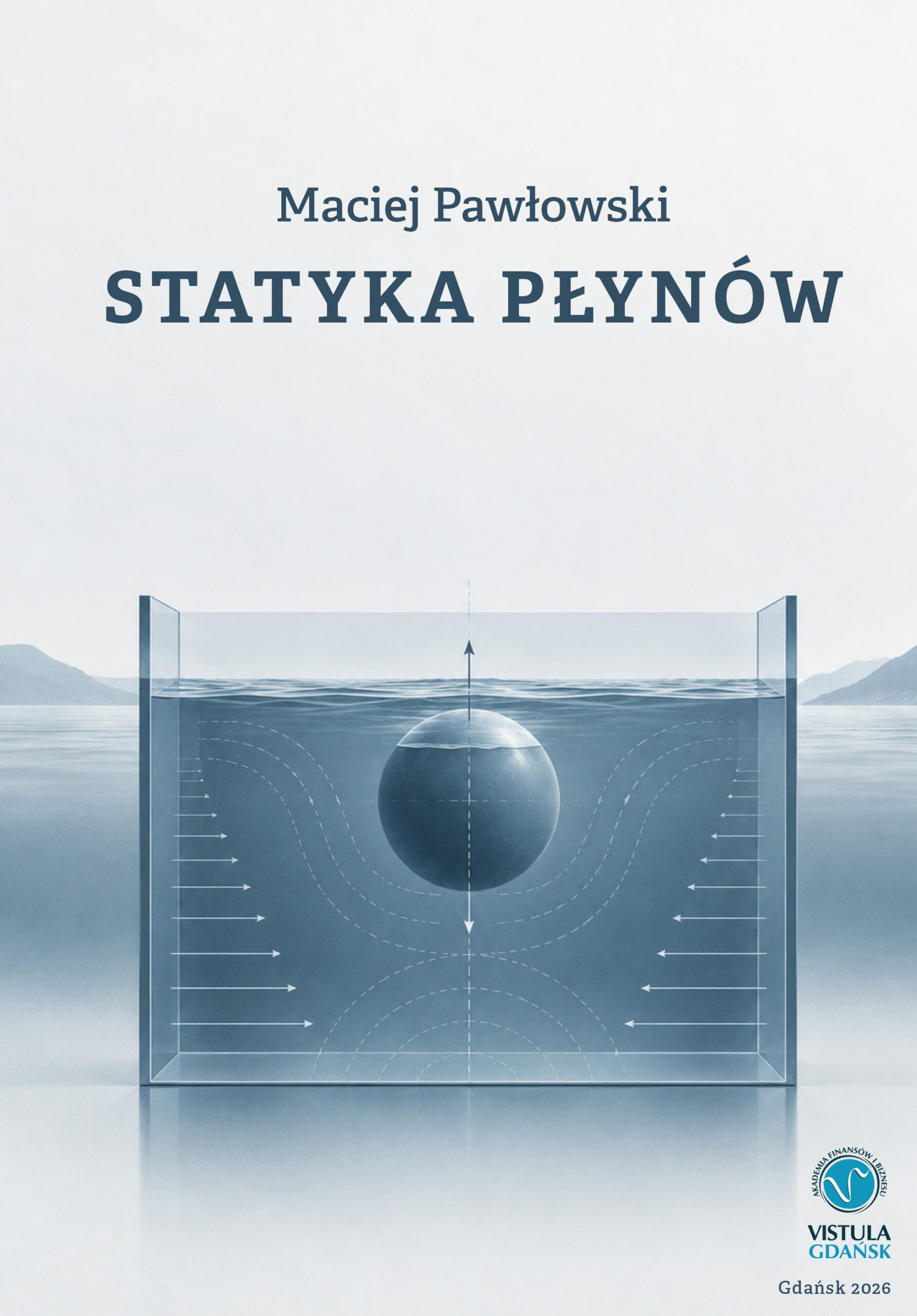
Podręcznik Statyka płynów poświęcony jest zagadnieniom mechaniki płynów w zakresie opisu cieczy pozostających w spoczynku. Opracowanie obejmuje zarówno podstawy teoretyczne hydrostatyki, jak i ich zastosowania w analizie rozkładu ciśnień oraz oddziaływania cieczy na powierzchnie stałe. Celem podręcznika jest systematyczne przedstawienie praw rządzących zachowaniem się cieczy w stanie równowagi oraz wykształcenie umiejętności ich praktycznego wykorzystania w zadaniach obliczeniowych.
W początkowych rozdziałach wprowadzono pojęcie pola hydromechanicznego oraz aparat matematyczny niezbędny do jego opisu. Szczególną uwagę poświęcono operatorom różniczkowym pola, takim jak gradient, dywergencja i rotacja, a także własnościom operatora nabla i operatorom podwójnym. Przedstawione narzędzia matematyczne stanowią podstawę dalszych rozważań nad warunkami równowagi płynu i analizą pola ciśnień w cieczy pozostającej w spoczynku.
Kolejne rozdziały omawiają warunki równowagi statycznej płynu oraz wynikający z nich rozkład ciśnień hydrostatycznych. Zaprezentowano zarówno klasyczny rozkład ciśnienia w cieczy jednorodnej w polu grawitacyjnym, jak i zagadnienie równowagi względnej cieczy, uwzględniające ruch układów odniesienia. Szczegółowo przeanalizowano przypadki częściowego i całkowitego wypełnienia cylindra cieczą, w tym sytuację cylindra zamkniętego, wskazując na wpływ przyspieszeń na kształt powierzchni swobodnej oraz rozkład ciśnienia.
Istotną część podręcznika stanowi omówienie rozkładu ciśnienia atmosferycznego wraz z wysokością, zarówno przy założeniu stałej temperatury, jak i jej zmiany wraz z wysokością. Przedstawione zależności pozwalają na ilościową ocenę spadku ciśnienia w atmosferze oraz jego znaczenia w zagadnieniach inżynierskich i fizycznych.
W dalszej części pracy przeanalizowano zagadnienia naporu cieczy na ściany płaskie oraz zakrzywione. Omówiono metody wyznaczania wartości i punktu przyłożenia siły naporu, a w przypadku powierzchni zakrzywionych również rozkład składowych siły oraz ich interpretację jako siły docisku lub ssania. Rozważania te uzupełniono omówieniem zjawiska przyssania oraz jego związku z polem ciśnień w cieczy.
Podręcznik zawiera także klasyczne prawa hydrostatyki, w szczególności prawo Pascala opisujące rozchodzenie się ciśnienia w cieczy oraz prawo Archimedesa dotyczące siły wyporu działającej na ciało zanurzone w płynie. Zagadnienia te zilustrowano przykładami o charakterze teoretycznym i praktycznym, a także omówiono wybrane paradoksy hydrostatyczne wynikające z właściwości pola ciśnień.
Całość uzupełnia pięć przykładowych zadań obliczeniowych oraz obszerny zestaw ćwiczeń, do których podano odpowiedzi i rozwiązania. Materiał dydaktyczny został dobrany w taki sposób, aby umożliwić samodzielne opanowanie podstaw hydrostatyki oraz przygotowanie do dalszych studiów z zakresu mechaniki płynów i nauk inżynierskich.
Podręcznik jest przeznaczony dla studentów kierunków technicznych związanych z inżynierią mechaniczną, kierunków okrętowych i budownictwa wodnego. Może być również przydatny w praktyce projektowej i pracy biur projektowych.
English description
Fluid Statics
The textbook Fluid Statics is devoted to selected problems in fluid mechanics concerning fluids at rest and in relative equilibrium. It covers both the theoretical foundations of hydrostatics and their applications to the analysis of pressure distributions and the forces exerted by fluids on solid surfaces. Its aim is to provide a systematic presentation of the laws governing fluids in equilibrium and to develop the ability to apply these laws in practical engineering calculations.
The opening chapters introduce the concept of a hydromechanical field and the mathematical tools required for its description. Particular attention is given to differential field operators such as the gradient, divergence and curl, as well as to the properties of the nabla operator and second-order differential operators. These mathematical tools provide the basis for the subsequent discussion of fluid equilibrium conditions and the analysis of pressure fields in fluids at rest. The treatment of composite operators, including the Laplacian, is consistent with the mathematical material presented in the textbook.
The following chapters discuss the conditions of static fluid equilibrium and the resulting distribution of hydrostatic pressure. Both the classical pressure distribution in a homogeneous liquid subjected to gravity and the relative equilibrium of liquids in moving reference systems are presented. Particular attention is given to cases in which a cylinder is more than or less than half filled with liquid, as well as to a closed cylinder, showing how acceleration affects the shape of the free surface and the pressure distribution.
An important part of the textbook is devoted to the variation of atmospheric pressure with altitude, both under the assumption of constant temperature and when temperature changes with altitude. The relationships presented make it possible to quantify the decrease in atmospheric pressure and to assess its significance in engineering and physical applications.
The subsequent chapters analyse hydrostatic forces acting on plane and curved surfaces. Methods are presented for determining both the magnitude of the resultant force and its point of application. In the case of curved surfaces, the components of the force and their interpretation in terms of contact or suction forces are also discussed. These considerations are complemented by an explanation of suction phenomena and their relationship to the pressure field in a fluid.
The textbook also presents the classical laws of hydrostatics, particularly Pascal’s law, concerning the transmission of pressure in a fluid, and Archimedes’ principle, concerning the buoyant force acting on a body immersed in a fluid. These topics are illustrated by theoretical and practical examples, together with selected hydrostatic paradoxes arising from the properties of pressure fields. These subjects correspond directly to the scope indicated in the original textbook summary and table of contents.
The book is supplemented by five worked calculation examples and an extensive set of exercises, with answers and solutions provided. The teaching material has been selected to support independent study of the fundamentals of hydrostatics and to prepare readers for further study in fluid mechanics and engineering sciences.
The textbook is intended for students of technical disciplines related to mechanical engineering, naval architecture and marine engineering, and hydraulic engineering. It may also be useful in engineering design practice and in the work of design offices.